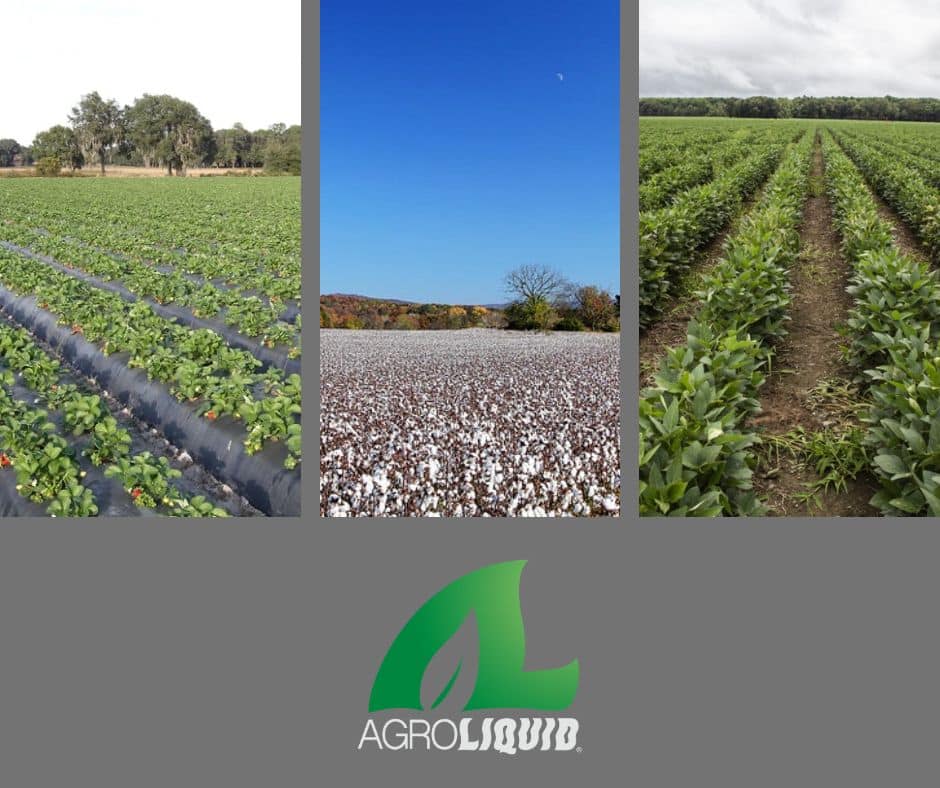
AgroLiquid has a long history of research-based data on what inputs work best for a variety of crops. One of our latest research focuses is on crops in the southern part of the United States.
“The research we are doing now is building the rates and timing of certain products specifically for the South,” said agronomist Gabe Saxon. “Our 40 years of research have taken place in a variety of regions, but this data is strictly from the southern states.”
Let’s look at three recent research trials and what we found:
LiberateCA and Kapitalize on Strawberries: Dover, FL
Experiment overview
- Objective: To evaluate the efficacy of AgroLiquid nutrient sprays for crop enhancement in Florida strawberries.
- Variety: Brilliance.
- Dates: Planted on October 18, 2024, and harvested on March 3, 2025.
- Methodology: Plants were transplanted manually onto 4-foot wide beds and sprayed seven times with a backpack sprayer between November 12 and February 18.
- Experimental design: Randomized complete block design with 30-foot plots, replicated four times.
Soil test data
The trial site reported the following soil characteristics:
- pH: 6.3
- CEC: 5.8
- % Organic Matter: 0.62%
Yield performance
The primary metric measured was the number of marketable “Flats per Acre” (Flats/A).
| Treatment | Yield (Flats/A) |
| Kapitalize + LiberateCa | 751 |
| Untreated | 694 |
| Kapitalize | 637 |
| LiberateCa | 617 |
Conclusions
- Marketable yield: While total yields were uniform across all treatments, the combination of Kapitalize with LiberateCa produced the highest number of marketable berries.
- Disease levels: Botrytis infection remained low throughout the trial, averaging only 3.9% of total yields across all treatments.
- Harvesting: Plots were harvested ten times to record marketable berry counts, weights, and botrytis-infected berry counts.
~
Kapitalize Soybean Rates: Mantee, MS
Experiment Overview
- Objective: To evaluate Kapitalize at various rates and growth stages in soybeans.
- Variety: P49Z02E.
- Dates: Planted on May 23, 2025, harvested on October 15, 2025.
- Yield goal: 75 bu/ac.
- Previous crop: Corn.
Soil test data
The soil at the Mantee, MS location showed the following properties:
- pH: 6.7
- CEC: 17
- Organic matter (%OM): 2.1%
- Phosphorus (Bray P1): 128 ppm
- Potassium (K): 520 ppm
Yield results (bu/ac): The trial compared different application rates (1, 2, or 3 gal/ac) and timings (V4-V7, R1-R2, or both). Kapitalize 1 gal/ac V4-V7 f/b R1-R2 resulted in the highest yield at harvest, producing 70.3 bu/ac.
Conclusions
- Highest yield: The application of Kapitalize at 1 gal/ac during V4-V7 followed by an additional 1 gal/ac at R1-R2 produced the highest yield of 70.3 bu/ac.
- Treatment vs. Untreated: Every treatment outperformed the untreated group, which had the lowest yield at 63.1 bu/ac.
~
Kalibrate and Kapitalize in Cotton: Mantee, MS
Experiment Overview
- Objective: To evaluate Kalibrate applied in-furrow at planting and Kapitalize applied as a foliar spray at first bloom.
- Variety: DP2328.
- Dates: Planted on May 16; Harvested on November 30.
- Yield goal: 2.5 Bales/Acre.
- Yield calibration: Results were calibrated for a gin turnout of 40%.
Soil test data
The trial site in Mantee, MS, showed the following soil characteristics:
- pH: 6.6
- CEC: 13.3
- Organic matter (%OM): 1.95%
- Potassium (K): 435 ppm
Cotton yield results (bales/acre)
| Treatment | Description | Yield (Bales/Acre) |
| Treatment 4 | Treatment 2 + Kapitalize 1 Gal at 1st Bloom | 3.94 |
| Treatment 2 | Kalibrate 2 Gal at Plant (In-furrow) | 3.49 |
| Treatment 1 | Untreated Check | 3.30 |
| Treatment 3 | Kalibrate 3 Gal at Plant (In-furrow) | 2.84 |
| Treatment 5 | Treatment 3 + Kapitalize 1 Gal at 1st Bloom | 2.65 |
Note: LSD P=.05 is 0.761.
Conclusions
- Best performer: The highest yield (3.94 bales/acre) was achieved by applying 2 gallons of Kalibrate in-furrow followed by a foliar application of Kapitalize at first bloom.
- Rate sensitivity: Applying 3 gallons of Kalibrate in-furrow actually resulted in lower yields than the untreated check, indicating that higher in-furrow rates may be detrimental.
- Application success: Using 2 gallons of Kalibrate in-furrow showed a yield increase over the check.
- Potassium management: The results suggest that even with sufficient soil potassium levels, correct application rates and timing of supplemental potassium can still increase yield.
~
Each of these research projects demonstrates that AgroLiquid’s foliar and in-furrow additives can improve yields. In the strawberry trial, the combination of Kapitalize and LiberateCa produced the highest marketable yield of 751 Flats/A, outperforming the untreated check by 57 Flats/A despite uniform total yields across all plots.
While all soybean treatments improved yield over the 63.1 bu/ac untreated baseline, the highest yield of 70.3 bu/ac was achieved with a lower rate of 1 gal/ac of Kapitalize applied at both the V4-V7 and R1-R2 stages.
Finally, the cotton trial in Mississippi emphasized the importance of precision in-furrow applications – applying 2 gallons of Kalibrate at planting followed by a Kapitalize foliar spray at first bloom maximized yield at 3.94 bales/acre.
Overall, the findings suggest that supplemental potassium and calcium applications are effective even in soils with sufficient base levels, provided that the timing aligns with reproductive stages.
~
Gabe Saxon is an AgroLiquid field agronomy manager in the Southeast region.
