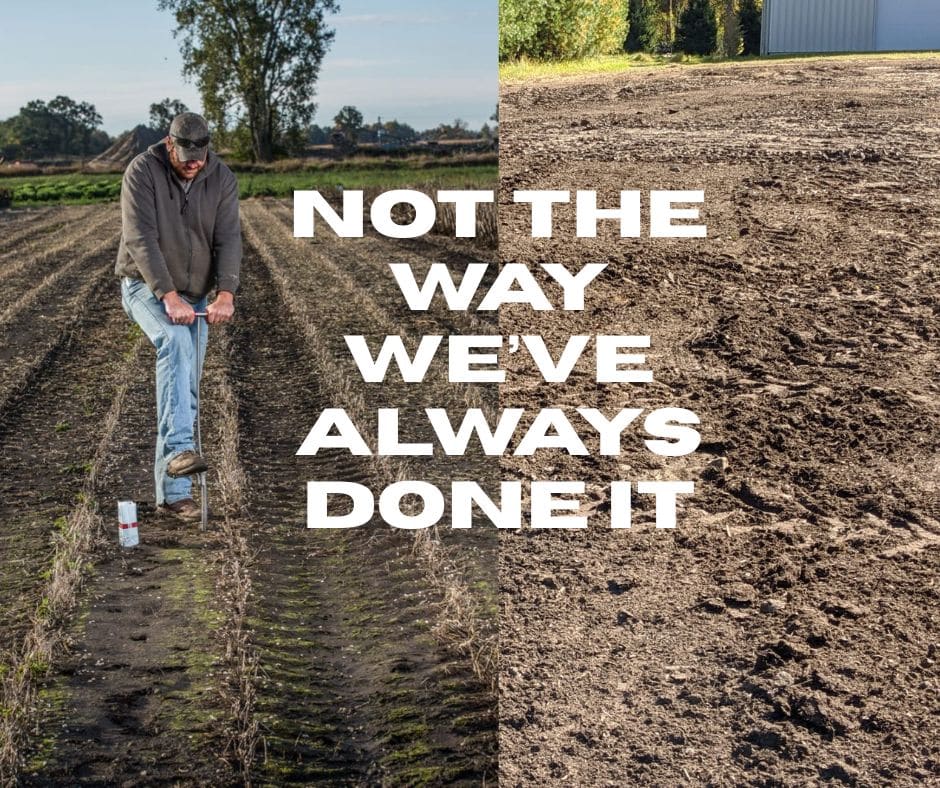
While seed genetics and equipment have advanced over time, many nutrient programs are still running on “the way we’ve always done it.” It’s time to stop guessing and start growing. By using the data behind soil testing, you can stop wasting input dollars and start feeding your crop what it needs.
It’s tempting to cut corners to save costs, but the one you can’t give up is soil testing.
Why soil testing
Soil testing tells you what you can’t see. With a soil test, you can find out:
- The present soil condition, including imbalances, deficiencies, and excesses
- How much nutrition is already available in the soil so that fertilizer applications can be tailored to those details
- Changes over time, with a multi-year testing program
- Soil characteristics, nutrition levels, and base saturation you can’t identify with your eyes
Of course, it costs money, but the costs currently average out to be less than $.50 per acre per year. Given the amount of information per penny, you can’t afford NOT to do soil testing.
Soil changes
If you’ve done soil testing in the past, is it still worth it to do it today?
Yes, due to a variety of factors. Over time, nutrient levels change due to loss through leaching or erosion, past fertilizer use, and when crops are removed. Plus, crops today take more nutrition than the yields of 30 years ago. Consider:
- Nutrients like sulfur or micronutrients have become more prominent
- Soluble nutrients like manganese and boron are difficult to build up in the soil
- Sulfur from manufacturing and power generation facilities is not as available as it was before the Clean Air Act, so using the same fertilizer mix you have always applied may not provide the best production or return
What you learn
A soil test can help you develop a complete nutrient management program, including how to adjust nutrient imbalances and find out what fertilizer crops need. If you use products that can be mixed, this will also provide the best ROI due to fewer passes on the field, time, and fuel savings.
Real-life application
In a field experiment by MGS Farms near Innerkip, Ontario, the soil test report for the field showed low levels of phosphorus and potassium.
- A common program in the area is an application of 5 gallons/acre of 6-24-6 liquid fertilizer that provides phosphorus and a small amount of potassium
- That treatment was compared to 2.5 gallons/acre of Pro-Germinator to meet the phosphorus need, or 2.5 gallons per acre each of Pro-Germinator and Sure-K to meet the phosphorus and potassium need
Result: Addressing the phosphorus and potassium need as proven by the soil test provided higher yield and higher net return compared to either no phosphorus or phosphorus fertilizer alone.

This highlights that following local standard liquid fertilizer routines can result in yield gaps when soil-specific deficiencies are ignored. By transitioning from a generic 6-24-6 application to a targeted phosphorus and potassium program, the study shows how inputs directly correlate to higher net profitability.
That’s not all the soil test shows.
Soil test reports also show relationships between nutrients in the soil. If one nutrient is in excess, other nutrients may not be available to the crop, even if the values of those nutrients are high.
For example, let’s look at manganese and iron. If the manganese level is higher than the iron level, there is a risk that iron will be less available to the crop. In that case, supplemental iron nutrition is recommended.
In addition, Mulder’s Chart shows how excess levels of calcium can reduce the availability of several nutrients, including phosphorus, potassium and manganese.
Start today
You (and your soil test!) don’t have to figure out your crop nutrition alone. Whether you have a question about a soil test or want to build a full-season plan together, we’d love to hear from you. Reach out to your AgroLiquid rep to get started.
~
John Leif is a an AgroLiquid field agronomy manager in the Northeast region.