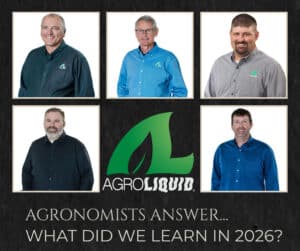
Every year is different in farming. Growers have to think about and adjust for the weather, the pests, the soil condition, and every other factor that affects a crop. Not only is it different across each farm, but it changes across each field.
As we end the year, we have the luxury of looking back. We asked our AgroLiquid agronomists: What did we learn in 2026?
Be patient
“Paying even more attention to soil conditions and soil health will have an effect on plant health and yields,” said John Leif, our AgroLiquid field agronomy manager. “Growers are better off when field work is done when soil is dry enough to prevent compaction.”
His advice? Basically, John suggests farmers try to be patient with their field work to avoid damaging wet soil, and to use soil products as a long-term investment in the health of their land.
“Providing soil amendments, including AgroLiquid’s carbon products, should prepare a soil for further improvements in future growing seasons,” John said.
Think big picture
Agronomist Nate Schroeder took a big-picture view about the grower experience in 2026.
“I learned to redefine winning,” Nate said. “Yield is a measurement. We have the ability to analyze so many data points within every crop season that yield is a component…but just a metric of a comprehensive analysis.”
Traditionally, farmers judged a winning season almost entirely by how much they harvested. Nate is saying that with modern agricultural data and technology, farmers can now look at the bigger picture. True success on the farm comes down to overall profitability, ROI, and efficiency – meaning a slightly lower yield with better managed input costs can actually be a bigger win than a record harvest that cost too much to produce.
Make the investment
Gabe Saxon, AgroLiquid agronomist, encourages growers not to give up on crop nutrition during a tough weather year.
“Even in a year with high temps and low moisture, feeding the crop at certain stages results in healthier plants and better yields,” he said. “Spoon feeding in a down year still creates an environment for success. It’s not as good in bad years as it is in good years, but it does always help.”
Fertilizer can’t replace rain, so growers won’t see great harvests during a drought. However, feeding the crop at the right time still prevents total crop failure and consistently produces a better harvest than doing nothing at all.
Never stop learning
Agronomist Abe Isaak reflected on the role of new technology.
“Technology and knowledge are growing very quickly in the time of AI,” Abe said. “What we know as truth today, tomorrow we may have to reevaluate because we have more knowledge. Just because we’ve done something a certain way in the past and it worked, doesn’t mean there’s not a new way of doing things because we have a better understanding.”
Of course, there’s always more to learn. Growers have made great achievements in farming over the years, but we’re always making more.
“We have a great knowledge about soils, but the truth remains, the unknown is still far larger than the knowledge we now possess,” Abe said.
While we can’t know what next year will bring, we can always be hopeful about the future. By bringing together the best information, research, and products, we can support growers every year, no matter the challenges. Contact your favorite AgroLiquid agronomist today!